Wednesday, September 12, 2012

Cutting Ribbons


The University of Rhode Island community celebrated the opening of two extraordinary buildings last week. One, the state-of-the art facility for the College of Pharmacy attracted enormous statewide attention (see http://www.uri.edu/news/releases/?id=6366). And rightfully so.   This building will provide an outstanding platform for educating generations of students, and its facilities will foster cutting-edge research.  The contributions of the graduates and the research programs will improve the health and lives of countless people.  Moreover, the advanced instrumentation and the modern manufacturing facility will help create new knowledge, new intellectual property, and products that can stimulate sustained economic development. This building represents a major investment in the university by the government and people of Rhode Island.  As noted in our web story, the University of Rhode Island had great partners in the design and construction of the pharmacy building. They, together with our amazing custodial crew and dozens of student volunteers, worked long hours to make the ribbon-cutting celebration a great success. Most importantly, the building we celebrated will provide a home for talented faculty, students, and staff who are dedicated to making a difference.
With much smaller crowds, and much less fanfare, the URI community and its partners dedicated another home just a few days later.  But it was just as special an occasion.  Over a hundred people, including many from the University of Rhode Island, gathered to celebrate the dedication of the first Habitat for Humanity house on the Old North Road site close to campus.  The completion of this house, the first in a four-unit complex, was an outcome of an inspirational partnership among South County Habitat for Humanity, URI, the town of South Kingstown and others.  As a direct result of this partnership the Stone family – Jay and Cora (a CCRI student), and their sons Jason and Eli – have their first home. 
What should make all of us at URI very proud are the generous and dedicated efforts of members of our community to make this happen. The partnership between South County Habitat for Humanity and URI developed in part through the determined efforts of Fran Noring (an Emeritus faculty member from the College of Human Science and Services).  In honor of her years of service and advocacy, the street for the Old North Village Project has been named for her.  Gail Faris (Assistant Director of the Women’s Center, now retired) and Jerry Sidio (Facilities Services, and advisor to our student Habitat chapter) were also instrumental in the success of this project.  In addition to the energetic and committed members of our student Habitat chapter, many of our student athletes and members of our Greek system devoted themselves to raising funds and to construction.  URI’s students in the Habitat chapter, our volleyball team, and the leadership of our sororities and fraternities have been an inspiration to the entire university. More details and pictures of the house dedication will be on our website soon. 
Thank you – everyone – who made these projects possible.  The completion of these buildings is a wonderful testimony to the importance and value of community.

Thursday, August 30, 2012

A Welcome to America's Greatest Assets


Beginning this weekend students arrive at the University of Rhode Island to begin our next academic year.  It’s an exciting time of year, especially for our new students and their families, but also for all of us in the URI community.  We begin this new academic year in the midst of significant challenges within a rapidly changing environment.  Given the magnitude and complexity of those global challenges facing us, I think that higher education has never been more important.  It will be, for the most part, the current and future generations of students – that’s you – who will have to craft or discover the solutions to issues ranging from building economic prosperity to dealing with climate change.  The University of Rhode Island is here to help prepare you to take on those challenges and issues. 
But we can only help.  Merely paying tuition and showing up does not guarantee that you will be prepared to succeed.  Recently another university president was quoted in Inside Higher Ed as saying: “The debate as to whether students are our customers is over. They have money and they have a choice of where or whether to invest in a college degree. That’s the definition of a customer.”  In my opinion, and with respect, he could not be more completely wrong.  First, I doubt many faculty would agree that the debate is over, and with good reason.  Second, students are not customers because an education is not a commodity nor a service that you can purchase. An education is not like cornflakes or help with your taxes. It would certainly be simpler if education was a commodity or a service, and perhaps that is part of the appeal for thinking about it in that way. 
In reality, your education depends as much on you as on the faculty.  Yes, they know a lot more about their subjects than you generally do. Collectively, they have devoted a great deal of time in continuously improving their teaching effectiveness and in creating new, relevant academic programs.  In the end, however, all their efforts – all their expertise, experience, and wisdom – will not matter if you think about your education the way you do your choice of cereal, or beverage, or your nail technician.  Your education is something you must actively create in partnership with the faculty. Your education will be as good, or as inadequate, as you want it to be.  Make no mistake, you can get a great education at the University Rhode Island, and that is precisely what we want for each of you. 
Why? Because you are our nation’s, the world’s, and the future’s greatest asset.  It’s not just the University of Rhode Island’s community that believes this.  The people of Rhode Island are investing over $77M this year in your education here. Thousands of URI alumni and friends have invested as well, providing scholarships and support for your education.  Frankly, I think that you are so important to the future that Rhode Island and the federal government should invest even more. 
Our competition certainly is. Sitting on my desk is a report entitled “The Competition that Really Matters. Comparing U.S., Chinese, and Indian Investments in the Next Generation Workforce.”  It is a sobering, 100 page report from the Center for American Progress and the Center for the Next Generation.  While in America we seem to be trapped by the “do more with less” mentality with regard to higher education, China and India have decided that it takes more to do more, and are rapidly increasing their investments in education at all levels.  Apparently they remember, even if we seem to have forgotten, the old American adage that “you get what you pay for”.  According to the report, China surpassed the United States in 2007 in the numbers of college graduates in science, engineering, and technology, and is now “the world’s largest provider of higher education.” India already awards more bachelor’s degrees than the U.S. and by 2020 will confer 4 times as many each year.  That is a lot of competition in the global economy.  Your opportunity to get a job and build a career will depend on how you do in that competition.  Your success will drive America’s success. 
That is why I think America needs to invest more, not less, in research, technology, and higher education.  Your success will strengthen that case. Since there are fewer of you, you will need to be better than our competition in order to keep America strong and prosperous.  I hope you enjoy your time here at the University of Rhode Island – college can, and should be, fun – but creating your education is a very serious matter.  Let’s work together to make your education everything it needs to be.  Welcome to URI.

Saturday, August 18, 2012

A New Mission


If you haven’t already, please check out the story on the University of Rhode Island’s web site about the Star Academy. Here’s the link: http://www.uri.edu/news/releases/?id=6338.  The First Star Academy at URI was founded to create opportunities for foster kids to prepare for college.  It is an excellent example of the kind of partnerships that the University of Rhode Island is committed to build.  In this instance the partners include First Star, a national non-profit organization (www.firststar.org), Hasbro, Adoption Rhode Island, and the state Department of Children, Youth, and Families. 
Some might ask: Why is URI doing this? Doesn’t this represent an expansion of the University’s mission at a time when budgets are tight? Why should this be a priority?  All fair questions.  The question of why is relatively straightforward to answer: the need is substantial. Only a few percent of kids who reach 18 in foster care go to college. Many end up homeless shortly after leaving the foster care system.  Opportunities are few and hope is scarce.  One can decry the choices and decisions of the parents, or the inefficiencies and shortcomings of programs intended to help, but the bottom line is that a large majority of kids who “graduate” from foster care at 18 face a blighted future with very few options for building a fulfilling, productive life.  We can help.
But why, then, should the University of Rhode Island take on this task?  Isn’t there enough to do, especially given the persistent fiscal constraints facing the university?  Where is such an endeavor to be found in the mission statement or the Academic Strategic Plan?  The answer to these questions, I believe, is to be found in the fundamental nature of the University of Rhode Island’s identity as a public, land-grant institution.  Universities like URI were created to provide a path for higher education for the common people, the “industrial classes” as referred to in the Morrill Act of 1862 – still one of the most visionary and influential acts of Congress ever passed.  The University of Rhode Island’s mission is to prepare people for success in the “several pursuits and professions of life.”  And that is precisely the goal of the First Star Academy at URI.  The Academy strives to prepare foster kids for college and for success – providing opportunity, choices, and hope.  And that is the core mission of the University of Rhode Island.
We’ve had a lot of success in this kind of work.  The Talent Development program (http://www.uri.edu/talent_development/) at the University of Rhode Island has assisted more than 1500 students to graduate who, owing to their own disadvantaged backgrounds, could not have expected to be able to attend URI.  Their success stories are an inspiration to all. In fact, a TD alumnus, Matt Buchanan, is the director of the First Star Academy at URI.
In the end, it makes excellent social and fiscal sense for the University of Rhode Island to be engaged with our partners in the First Star Academy, in Talent Development, and in many other ways to provide opportunity and a path to success for students who would not otherwise have had much of a chance.  Here in Rhode Island, and across the nation, pursuing strategies that will help in revitalizing the economy, creating jobs, and growing incomes may well be the surest path to restoring support for public higher education.  Further, it seems to me that the current social and political context in America argues for a better-informed and more engaged citizenry.  That is also certainly a part of the historic land-grant mission. 2012 marks the 150th anniversary of the Morrill Act, and I can think of no better way to celebrate it than by renewing our efforts, and creating new ways, to provide education, opportunity, and hope to all Americans.

Wednesday, July 25, 2012

Summits


Many of you have heard me say that one of the true highpoints (or summits) of my time as President of the University of Rhode Island has been getting to know the university’s alumni.  Lynn and I had an unusual opportunity to meet more of our graduates when we hosted an event at our home in Bozeman, Montana. Alumni and members of their family came, in several cases, more than 100 miles (a couple more than 300 miles!) to join us.  Participants included Lee Mongeon (1952), Elizabeth Mongeon (1952), Alden Paterson (1958), Jessica Pugrud (1977), Dayl Taylor (1978), Jennifer Madgic (1998), Sandy Leclerc (2000) and members of the families, as well as guests.  We had a great time. Since many more alumni from the region sent their regrets along with their hopes that there would be another opportunity, Lynn and I will do this again.

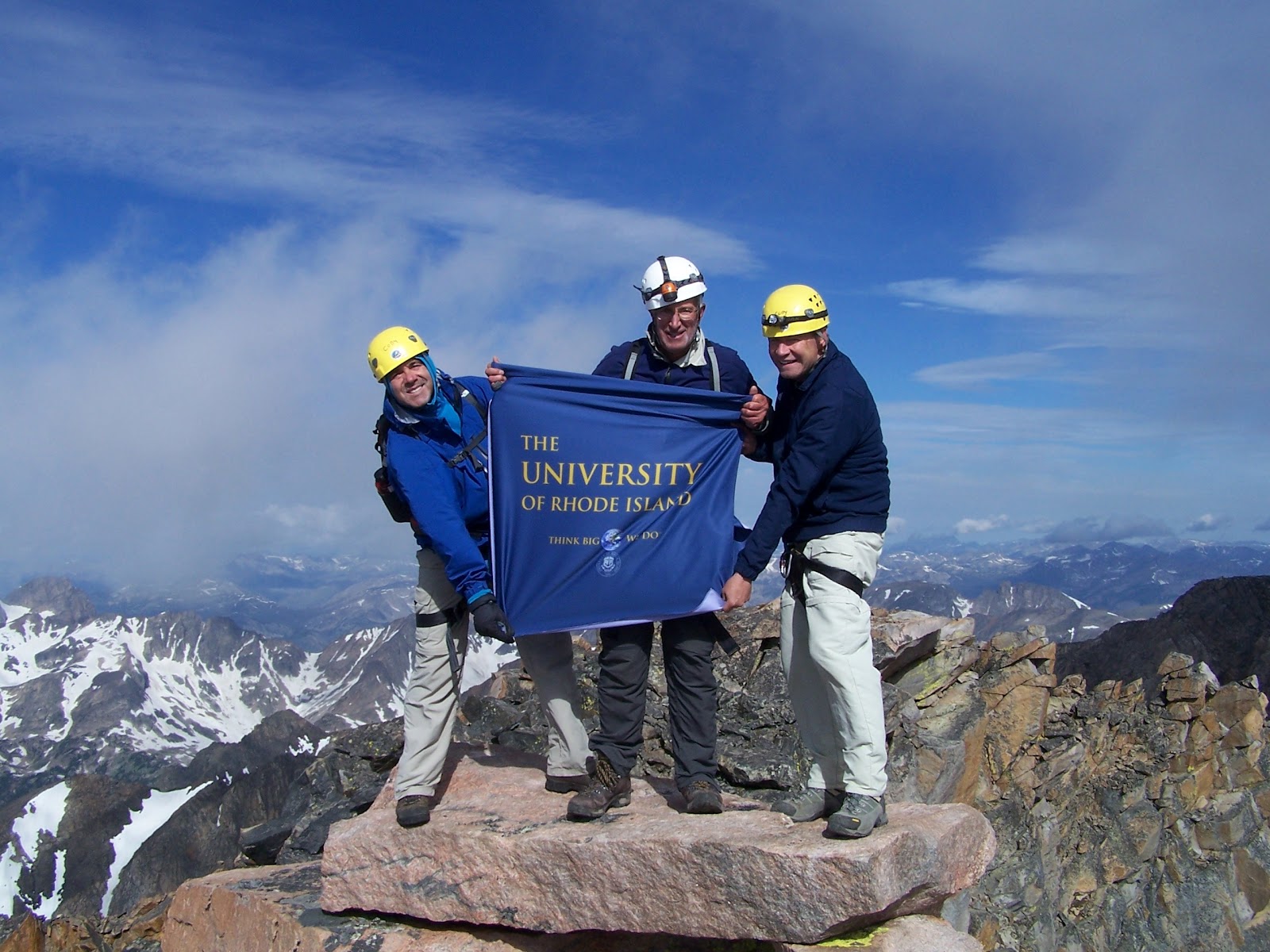
Bruce Gouin (1974) of Arrowhead Dental Associates here in Rhode Island also attended.  Shortly afterward he, Frank DeQuatrro (1983), an orthodontist in RI, and I set off for a different kind of highpoint: the summit of Granite Peak, the highest point in Montana.  Here is a brief account of our four-day climb and return.


Here is a view of Granite Peak from the "high camp" on Froze to Death Plateau.


A closer view of Granite (again from Froze to Death Plateau). The route to the summit
initially follows the ridge on the left and then moves to the back of the peak.


Left to Right on the summit of Granite Peak: Frank, Bruce, and me.  Elevation about 12,800 ft.  


Coming down after the climb: Bruce, me, our guide, Phil, and Frank.
Mystic Lake (elev. ~ 7,000 ft) is below us.

Monday, June 4, 2012

Why Study the Arts and Humanities?


I recently returned from Europe following meetings with key partners in our acclaimed International Engineering Program – one of the University of Rhode Island’s most innovative and effective educational programs.  Our program was, in fact, recently featured in the Chronicle of Higher Education.  My schedule has not been conducive to writing. Commencement occupied practically every moment since returning from the trip. The normal inclination would be to write on an aspect of Commencement, but I wanted instead to take the time to write on another subject.  That topic, in my opinion, is just as important, although perhaps not as obviously so, as educating engineers who are fluent in languages other than English, and who possess genuine cross-cultural competencies.
It appears inevitable, in the current climate, for commencement to stimulate stories in the media about the bleak job market for new graduates.  That is a very real concern for many of our graduates and their families.  What should be done?  Well, practically everyone recognizes that the employment prospects for college graduates are a function of one’s major.  Graduates in science, engineering, a professional field, or business generally do have more options and an easier path to a job directly related to their major.  In contrast, graduates in the arts and humanities are generally believed to have significantly fewer opportunities, especially in this current economy.  There is truth to that; there is also truth to the proposition that our nation could use more graduates in science, engineering, technology, and math. One consequence is that, for as long as I can remember, parents have been encouraging their kids to major in subjects that have an obvious and demonstrable connection to a job.  Frequently the son or daughter resists or rejects the advice. I saw a lot of this while on the faculty at Amherst College: parents encouraging (or even demanding) that their student prepare for business, medicine, or law – and the student choosing another path.  And that, much more often than not, turned out just fine.
Yes, unemployment and underemployment of college graduates is higher now, and student debt has grown alarmingly.  These are consequences of a severe and prolonged economic downtown coupled with the systematic disinvestment in public higher education by government in America. 
But, study of the humanities and the arts also remains valuable, for a wide variety of reasons. Not least, a strong liberal arts education can provide a valuable foundation for careers in a host of areas, as wonderfully demonstrated by the University of Rhode Island’s student commencement speaker, Mary McGunigal, who majored in Classics but is headed to the Mount Sinai School of Medicine.  The skills of critical reading and thinking, strong writing, and effective presentation are essential in practically any career. The ability to learn continuously, to teach oneself, are also more important than ever.  Creativity, a strong work ethic, self-discipline, and teamwork have always been, and will continue to be, keys to success.   All of our majors at the University of Rhode Island provide students the opportunities to develop these attributes.  There is a lot of evidence to indicate that a strong liberal arts education can be the foundation for success after college.  Most notably, even a cursory examination of the worlds of business, health, education, law, communications, and many others reveals that all of them are highly populated by leaders and professionals whose academic backgrounds are in the humanities and the arts. 
Despite this, it is probably natural that in tough economic times students tend to gravitate towards majors that have a more direct connection to employment possibilities. As one possible indicator of this, a recent NSF report showed that graduate enrollments in science, health, and engineering had grown by 30% over the last decade.  On the whole, that is a good thing, I think.  But what if your talents and interests while in college lie in areas other than science, engineering, health, or business?  A well-worn truism, that retains substantial validity in my judgment, is to pursue what you are passionate about, to study those things that you are truly, and deeply, motivated to study. A great example for me is the career of URI’s commencement speaker and honorary degree recipient, Marlen Suyapa Bodden.  She majored in history and Spanish literature at Tufts. People might have thought that such a double major would be inadequate preparation if you really wanted to build a distinguished career and change the world.  If anyone shared that kind of assessment with Marlen, she did not listen – and consequently our nation and the world are a better place.  I believe that many of the University of Rhode Island’s recent graduates can have a similar impact, regardless of what they may have majored in.  Commencement is the time we most clearly acknowledge and celebrate the truth of that hope.  So I suppose this post turned out to be about commencement after all!

Saturday, April 21, 2012

Frivolous (or at least misguided) Suggestions to “Improve” Higher Education


OK, in my most recent post I argued that it is time to be really serious about the problems confronting American higher education, especially public colleges and universities.  I implied that some of the “problems” and some “solutions” were, well, less than serious. That raises the obvious question: So what specifically do you regard as less than serious or even frivolous contributions to the discussion?  Here’s my answer.  I apologize in advance for its length, but, even so, there is a lot more that could be said on these complex issues.
First, let’s end the foolishness of talking endlessly about access and affordability while saying nothing about quality.  Yes, the student loan situation is a looming crisis that we absolutely must address. But there is one thing worse than graduating from college with a lot of debt.  That is graduating from college unprepared to succeed in the intensely competitive global economy.  In fact, that’s much, much worse.
Second, let’s acknowledge that not everyone needs a college education.  There are good jobs out there that do not yet require one.  But a lot of the best jobs and careers do, and will continue to, require some amount of post-secondary education, if not a college degree or even a graduate degree.  And the percentage of the jobs that do will likely increase.  A college degree is still the greatest driver of upward mobility in America. That said, we should pay no attention to those who argue that a college education is no longer needed based on the success of a Steve Jobs or a Bill Gates. That is just silly.  These individuals are extremely rare. Moreover, this argument completely ignores the fundamental fact that the success of Apple and Microsoft is built on the innumerable, essential contributions of thousands of engineers, programmers, designers, managers, business professionals, and more – the vast majority of whom have college degrees.  While the odds of any particular 20-year-old being the next Bill Gates or Steve Jobs are very low, the opportunities to build a successful, productive, rewarding career – or a new company  – in the technology sectors of the global economy are still high, but only if you go to college.
Next, let’s dispense with the tripe that distance education is some kind of panacea for the issues surrounding access, quality, and affordability. That’s not to say that distance education and web-based learning are unimportant. To the contrary, they are essential tools to improving learning and access. We in higher education should be “all in” with regard to adopting, implementing, and developing technologies to improve access and student success.  The lecture is far past its expiration date for many of our classes.  However, teaching in laboratories, in the field, seminars, supervised internships, studios, and tutorials is more important than ever, and cannot be satisfactorily replicated on line, if at all.  Nor should we underestimate the value of students and faculty interacting face to face in a learning and social community, developing relationships and interpersonal skills not readily created through distance learning. One of the most important advantages of teaching-learning technology is to free up faculty time for engaging students directly in hands-on learning, research, and creative work.  Especially in science and engineering (which continue to be among our nation’s critical needs) laboratory or fieldwork, or both, is simply a necessity.  A virtual laboratory does not adequately replicate being in a laboratory, actually conducting experiments, and making your own mistakes. A video of a stream is not the same as standing in it, sampling the water or the organisms, or just closely observing an ever-changing microenvironment. Designing and building a robot is completely different than watching one.  There’s a lot more that could be said in this context, but I hope you get the idea. 
While we’re at it, let’s develop a realistic attitude towards “for-profit” education. It certainly has its place among America’s higher education options. It serves a lot of students very well.  It has, and can continue to, teach public and private colleges and universities a lot, particularly with regard to high-quality distance and web-based teaching strategies.  But it must also be remembered that the primary constituency of a for-profit institution is its owners or shareholders. The primary motivation is, well, profit.  It seems to me that students tend to be regarded as customers.  I think that attitude is fundamentally flawed.  Students are not our customers, they are, or should be, our partners.  A college education is not a commodity to be selected from a display like cornflakes or oatmeal.  I believe that a college education is a creative endeavor involving close collaboration between the student and the faculty.  Each must contribute to the creative process; without that partnership some type of credential may be awarded, but the kind of education that would most benefit the student has not been created.  Also, we should not lose sight of the fact that net revenue is a leading driver of academic offerings at for-profit institutions. It is one reason, I suspect, that programs in science, engineering, clinical practice, and anywhere where small student/faculty ratios are required, tend to be underrepresented in that sector.
Of course, net revenue considerations are also a part of the planning and resource allocation strategies of public colleges and universities.  In the current fiscal climate the need for such considerations is frequently acute. A net revenue approach can be valuable in multiple contexts, such as setting priorities and insuring that resources follow students.  It can also all to easily get out of hand.  Expensive programs in the sciences, engineering, nursing, pharmacy, and allied health, are unarguably critical to our future. So are philosophy, literature, foreign languages, history, the social sciences, the arts, and yes, even, anthropology.  Even in the midst of financial affliction, we must constantly keep the fundamental purposes of higher education foremost in our planning and decisions – one of those purposes is to prepare our students for success as thoughtful, knowledgeable, informed, and engaged citizens. 
Finally, can we dispense with the specious argument that faculty productivity and salaries are a major cause of rising costs? Faculty salaries, even for those on the tenure-track, have been nearly stagnant for several years, especially at public colleges and universities.  Moreover, practically everyone knows that adjunct faculty are increasingly teaching our students and that the percentage of tenure track faculty has been declining. Why? Because adjuncts are substantially cheaper, particularly if part-time. The trend towards more adjuncts and part-time faculty needs to be reversed, not exacerbated. Are there slackers out there? Of course.  Would increased accountability be useful? You bet. Those are problems we have the tools to fix.  In fixing those problems let’s not lose sight of the fact that our faculty generally work hard, accomplish a lot, care about students, and are passionate about teaching, scholarship, and service.  For many colleges and universities I think the data indicate that our faculty deserve more, not less, in terms of salary. 
Whew! I’m glad to get all that off my chest. I feel better, although you probably don’t. Thanks for reading anyway.

Friday, April 13, 2012

Let's Be Serious

A memorable line from the movie The American President is: “We have serious problems to solve, and we need serious people to solve them.” It is a line for our time in higher education. Each day seems to bring a new problem to the fore. The list of problems appears endless: student loan debt, institutional debt, rapidly increasing tuition, achievement gaps, corporatization, the erosion of tenure, the future of the humanities, athletics scandals and spending, deferred maintenance, growing restrictions on student access, escalating demand to attend college, reductions in research funding, international competition, too few opportunities for new (or not so new) PhDs, the “graying” of the faculty, the lack of diversity among senior leaders – and we can add a lot more to that list. It can be depressing if one dwells on it.

There also appears to be no shortage of proposed solutions to at least some of these problems: let’s privatize, abolish tenure, foster “destructive” innovation, outsource, consolidate, partner, grow, shrink, provide credentials not degrees, increase oversight – and we can add a lot more to that list, too. Some of the proposals that have been made are worthwhile, some are misguided, some are frivolous, and some are really threats.

In order to solve a problem you must be able to identify it – but in the current context for higher education that is less obvious that you might first think. If you set out to design the next generation airliner, say the Boeing 787, everyone understands that if you elegantly solve all the design problems, but leave off the engines, you are unlikely to sell many aircraft, and even less likely to get passengers from Boston to Shanghai. Yet many of the solutions to the multiple problems facing higher education are just like that – useful, even necessary (like landing gear), but ultimately irrelevant without the engines. Unless we address the fundamental problems of funding, for both public institutions and for students, the rest of our efforts will not matter very much.

A recent report, a new addition to a substantial group that reach the same conclusion, cogently documents the engine problem for public higher education. The paper is aptly titled, “The Great Cost Shift. How Higher Education Cuts Undermine the Middle Class.” The author is John Quinterno, writing for Demos, a non-partisan public policy research and advocacy organization in NY, www.demos.org. The numbers for Rhode Island are especially sobering. In 1990-91 Rhode Island provided $205 per capita or $6.71 per $1000 of personal income to public higher education. By 2010-2011 those values had declined to $150 per capita and $3.55 per $1000 of personal income. Now that is a serious problem.

Moreover, it is a fundamental problem, and until this problem is solved we will have a difficult time really solving any of our myriad other problems. For example, the tension between maintaining and improving quality on one hand (which requires us to develop, recruit, and retain the best faculty and staff we can), and minimizing tuition increases on the other, is increasingly problematic in the context of systematic declines in state support.

The public disinvestment in higher education is a national problem, which makes it even more difficult to solve. But solve it we must, for the benefit of our state and our nation. Finding a solution requires a serious examination of the problem by serious people committed to the search. Currently, here in Rhode Island, the Board of Governors for Higher Education, the General Assembly, and the Governor’s Office have all engaged the issue of access and affordability, which is encouraging. But we must directly face the reality that the “cost” crisis is in fact a funding crisis. We have a long way to go to solve that problem, and no time to waste.