Monday, October 15, 2012

America's Spending Priorities


America is nearing the end of its most expensive political campaign season ever.  According to the Washington Post, Presidential campaigns and the super PACS that support them will spend more than $2 billion by Election Day.  Add in the Congressional races and the total climbs to approximately $5.8 billion, and could go higher (http://www.opensecrets.org/news/2012/08/2012-election-will-be-costliest-yet.html).  That is a staggering number.
I would guess that most of us are tired of, if not dismayed by, the strident tone, the inaccuracies, and the cumulative, relentless negativity of the campaigns. All too frequently what we see, hear, and read during the campaigns appears to have the purposes of generating fear, not hope; of creating divisions, not unity; of fomenting hatred, not kindness; of obscuring the truth, not revealing it; of sowing confusion, not understanding.  I am concerned that the end result of such campaigns is a weaker America, not a stronger one. It seems to me that, if America is to retain its global leadership, and be a model of representative, democratic government for the world, then our government needs to function effectively and well.  However, it appears that we are devoted to spending billions to insure just the opposite.
A grave example of our current inability to govern ourselves is the looming fiscal cliff over which we are poised to leap in January 2013. The consequences of the mandated, massive reductions in discretionary spending will be truly devastating to America’s economic prosperity and global leadership. Why?  Because the scheduled reductions of $57.5 billion over 2013-2017 in America’s funding for research and development (see http://www.aaas.org/spp/rd/fy2013/SeqBrief.shtml) will inflict wide-spread and debilitating damage to our nation’s capabilities in science, engineering, and technology. 
Unless amended, research and development in the Department of Defense, Homeland Security, the National Science Foundation, the National Institutes of Health, the Department of Commerce, NASA, the Department of Energy, the Environmental Protection Agency, the Department of Agriculture, and the Department of the Interior will be reduced substantially.  America’s security and prosperity will be damaged for years to come. 
This threat is a product of the debilitating, uncompromising partisanship generated in part by the last election.  And now we appear to be spending billions in an all-out effort to make our situation worse, many of our citizens more alienated, and our competitive position weaker. Meanwhile, India, China, the EU and others are pouring resources into research, development, and higher education. 
What should be done?  Well first, we should insist that the President and Congress build a bipartisan solution to avoid the mandated budget reductions and tax increases set to begin in 2013. It is, after all, exactly what they intended – that these potentially devastating steps would create powerful incentives to craft an acceptable budget compromise. I do not know what the most effective solution to the current poisonous election climate might be. But no one ever solved a problem without admitting it existed. Let’s do that, and then work together on the solution. I think America’s colleges and universities can play an important role in crafting the solution.  We should intensify our efforts to promote and facilitate reasoned debate on America’s policy options. We should advocate strengthening the roles of critical analysis, scientific data, and accurate information in decision-making and policy development.  And we should strive to build the kinds of communities on our campuses where discourse and debate are civil, responsible, and respectful.  Our research universities have helped America solve large problems in the past and we can do so again. 

Friday, September 28, 2012

Look Beyond Yourself

This year’s Honors Colloquium, focused on health care, began with a talk by the celebrated author Tracy Kidder.  Mr. Kidder spoke about his influential and moving book, Mountains Beyond Mountains, an examination of the life and work of Dr. Paul Farmer.  Dr. Farmer has devoted himself to providing care and healing to some of our planet’s poorest people afflicted with HIV and tuberculosis.  During the question period following his talk, a member of the audience asked Mr. Kidder for his personal judgment of Dr. Farmer. His response was both brief and memorable: “I’m glad he lived here on earth.”
It is a judgment from those that know us that we should all strive to earn.  Many fail this simple test.  Unique combinations of factors can have a profound influence on each individual, and upon whether their time here on earth brings joy to those who know them. Every individual is different, but I would argue that we do have the common capacity to bring joy to those around us – or not.
My question here is: can college assist us in becoming the kind of person whose life would be judged as Mr. Kidder judged Dr. Farmer?  I think so.  There are probably many, many ways that learning, scholarship, serving, and being a part of a community, can develop in us the character and the determination to lead a life that brings joy to others.  But one thing, it seems to me, is a prerequisite.  We must be able to look beyond ourselves and place our efforts in a larger, outward-directed context.
Mr. Kidder spoke to this very requirement. In response to a question he stated that studying and learning – even subjects like organic chemistry – should be informed and motivated by our larger purpose.  He suggested that the goal of what we want to accomplish in our lifetime should be foremost.  Is it to heal people?  Then organic chemistry matters a lot. Is it to teach kids?  Then, in addition to the subject we aspire to teach, other subjects – like child psychology and human development – are important, too.  Seen from the summit of our larger purpose, every step upward to that goal is important, even indispensable.
That’s not to say that it is easy to maintain such a perspective. There may be times when a single step up is followed by a difficult slide down.  But every upward step matters. Keeping the goal in mind matters even more.  A university community, like that at the University of Rhode Island, can help refine, or define, our purpose in life and our goals for life.  In addition to courses, studios, and labs, participation in service learning, internships, volunteering, a living-learning community, student government or organizations, can all help identify the compelling interest or motive that can define a life.  That is why we offer all those things here, and why a rigorous learning environment and a strong, supportive community are both critical.
In the end it is up to each of us. We can choose to live a life with a purpose beyond our personal comfort, or not.  We can strive to be the kind of person that makes others glad they shared time with us, or not.  I believe that an important goal for the University of Rhode Island is to build an environment and a community that encourages all its members to create a life with a purpose beyond ourselves.  I hope you agree.

Wednesday, September 12, 2012

Cutting Ribbons


The University of Rhode Island community celebrated the opening of two extraordinary buildings last week. One, the state-of-the art facility for the College of Pharmacy attracted enormous statewide attention (see http://www.uri.edu/news/releases/?id=6366). And rightfully so.   This building will provide an outstanding platform for educating generations of students, and its facilities will foster cutting-edge research.  The contributions of the graduates and the research programs will improve the health and lives of countless people.  Moreover, the advanced instrumentation and the modern manufacturing facility will help create new knowledge, new intellectual property, and products that can stimulate sustained economic development. This building represents a major investment in the university by the government and people of Rhode Island.  As noted in our web story, the University of Rhode Island had great partners in the design and construction of the pharmacy building. They, together with our amazing custodial crew and dozens of student volunteers, worked long hours to make the ribbon-cutting celebration a great success. Most importantly, the building we celebrated will provide a home for talented faculty, students, and staff who are dedicated to making a difference.
With much smaller crowds, and much less fanfare, the URI community and its partners dedicated another home just a few days later.  But it was just as special an occasion.  Over a hundred people, including many from the University of Rhode Island, gathered to celebrate the dedication of the first Habitat for Humanity house on the Old North Road site close to campus.  The completion of this house, the first in a four-unit complex, was an outcome of an inspirational partnership among South County Habitat for Humanity, URI, the town of South Kingstown and others.  As a direct result of this partnership the Stone family – Jay and Cora (a CCRI student), and their sons Jason and Eli – have their first home. 
What should make all of us at URI very proud are the generous and dedicated efforts of members of our community to make this happen. The partnership between South County Habitat for Humanity and URI developed in part through the determined efforts of Fran Noring (an Emeritus faculty member from the College of Human Science and Services).  In honor of her years of service and advocacy, the street for the Old North Village Project has been named for her.  Gail Faris (Assistant Director of the Women’s Center, now retired) and Jerry Sidio (Facilities Services, and advisor to our student Habitat chapter) were also instrumental in the success of this project.  In addition to the energetic and committed members of our student Habitat chapter, many of our student athletes and members of our Greek system devoted themselves to raising funds and to construction.  URI’s students in the Habitat chapter, our volleyball team, and the leadership of our sororities and fraternities have been an inspiration to the entire university. More details and pictures of the house dedication will be on our website soon. 
Thank you – everyone – who made these projects possible.  The completion of these buildings is a wonderful testimony to the importance and value of community.

Thursday, August 30, 2012

A Welcome to America's Greatest Assets


Beginning this weekend students arrive at the University of Rhode Island to begin our next academic year.  It’s an exciting time of year, especially for our new students and their families, but also for all of us in the URI community.  We begin this new academic year in the midst of significant challenges within a rapidly changing environment.  Given the magnitude and complexity of those global challenges facing us, I think that higher education has never been more important.  It will be, for the most part, the current and future generations of students – that’s you – who will have to craft or discover the solutions to issues ranging from building economic prosperity to dealing with climate change.  The University of Rhode Island is here to help prepare you to take on those challenges and issues. 
But we can only help.  Merely paying tuition and showing up does not guarantee that you will be prepared to succeed.  Recently another university president was quoted in Inside Higher Ed as saying: “The debate as to whether students are our customers is over. They have money and they have a choice of where or whether to invest in a college degree. That’s the definition of a customer.”  In my opinion, and with respect, he could not be more completely wrong.  First, I doubt many faculty would agree that the debate is over, and with good reason.  Second, students are not customers because an education is not a commodity nor a service that you can purchase. An education is not like cornflakes or help with your taxes. It would certainly be simpler if education was a commodity or a service, and perhaps that is part of the appeal for thinking about it in that way. 
In reality, your education depends as much on you as on the faculty.  Yes, they know a lot more about their subjects than you generally do. Collectively, they have devoted a great deal of time in continuously improving their teaching effectiveness and in creating new, relevant academic programs.  In the end, however, all their efforts – all their expertise, experience, and wisdom – will not matter if you think about your education the way you do your choice of cereal, or beverage, or your nail technician.  Your education is something you must actively create in partnership with the faculty. Your education will be as good, or as inadequate, as you want it to be.  Make no mistake, you can get a great education at the University Rhode Island, and that is precisely what we want for each of you. 
Why? Because you are our nation’s, the world’s, and the future’s greatest asset.  It’s not just the University of Rhode Island’s community that believes this.  The people of Rhode Island are investing over $77M this year in your education here. Thousands of URI alumni and friends have invested as well, providing scholarships and support for your education.  Frankly, I think that you are so important to the future that Rhode Island and the federal government should invest even more. 
Our competition certainly is. Sitting on my desk is a report entitled “The Competition that Really Matters. Comparing U.S., Chinese, and Indian Investments in the Next Generation Workforce.”  It is a sobering, 100 page report from the Center for American Progress and the Center for the Next Generation.  While in America we seem to be trapped by the “do more with less” mentality with regard to higher education, China and India have decided that it takes more to do more, and are rapidly increasing their investments in education at all levels.  Apparently they remember, even if we seem to have forgotten, the old American adage that “you get what you pay for”.  According to the report, China surpassed the United States in 2007 in the numbers of college graduates in science, engineering, and technology, and is now “the world’s largest provider of higher education.” India already awards more bachelor’s degrees than the U.S. and by 2020 will confer 4 times as many each year.  That is a lot of competition in the global economy.  Your opportunity to get a job and build a career will depend on how you do in that competition.  Your success will drive America’s success. 
That is why I think America needs to invest more, not less, in research, technology, and higher education.  Your success will strengthen that case. Since there are fewer of you, you will need to be better than our competition in order to keep America strong and prosperous.  I hope you enjoy your time here at the University of Rhode Island – college can, and should be, fun – but creating your education is a very serious matter.  Let’s work together to make your education everything it needs to be.  Welcome to URI.

Saturday, August 18, 2012

A New Mission


If you haven’t already, please check out the story on the University of Rhode Island’s web site about the Star Academy. Here’s the link: http://www.uri.edu/news/releases/?id=6338.  The First Star Academy at URI was founded to create opportunities for foster kids to prepare for college.  It is an excellent example of the kind of partnerships that the University of Rhode Island is committed to build.  In this instance the partners include First Star, a national non-profit organization (www.firststar.org), Hasbro, Adoption Rhode Island, and the state Department of Children, Youth, and Families. 
Some might ask: Why is URI doing this? Doesn’t this represent an expansion of the University’s mission at a time when budgets are tight? Why should this be a priority?  All fair questions.  The question of why is relatively straightforward to answer: the need is substantial. Only a few percent of kids who reach 18 in foster care go to college. Many end up homeless shortly after leaving the foster care system.  Opportunities are few and hope is scarce.  One can decry the choices and decisions of the parents, or the inefficiencies and shortcomings of programs intended to help, but the bottom line is that a large majority of kids who “graduate” from foster care at 18 face a blighted future with very few options for building a fulfilling, productive life.  We can help.
But why, then, should the University of Rhode Island take on this task?  Isn’t there enough to do, especially given the persistent fiscal constraints facing the university?  Where is such an endeavor to be found in the mission statement or the Academic Strategic Plan?  The answer to these questions, I believe, is to be found in the fundamental nature of the University of Rhode Island’s identity as a public, land-grant institution.  Universities like URI were created to provide a path for higher education for the common people, the “industrial classes” as referred to in the Morrill Act of 1862 – still one of the most visionary and influential acts of Congress ever passed.  The University of Rhode Island’s mission is to prepare people for success in the “several pursuits and professions of life.”  And that is precisely the goal of the First Star Academy at URI.  The Academy strives to prepare foster kids for college and for success – providing opportunity, choices, and hope.  And that is the core mission of the University of Rhode Island.
We’ve had a lot of success in this kind of work.  The Talent Development program (http://www.uri.edu/talent_development/) at the University of Rhode Island has assisted more than 1500 students to graduate who, owing to their own disadvantaged backgrounds, could not have expected to be able to attend URI.  Their success stories are an inspiration to all. In fact, a TD alumnus, Matt Buchanan, is the director of the First Star Academy at URI.
In the end, it makes excellent social and fiscal sense for the University of Rhode Island to be engaged with our partners in the First Star Academy, in Talent Development, and in many other ways to provide opportunity and a path to success for students who would not otherwise have had much of a chance.  Here in Rhode Island, and across the nation, pursuing strategies that will help in revitalizing the economy, creating jobs, and growing incomes may well be the surest path to restoring support for public higher education.  Further, it seems to me that the current social and political context in America argues for a better-informed and more engaged citizenry.  That is also certainly a part of the historic land-grant mission. 2012 marks the 150th anniversary of the Morrill Act, and I can think of no better way to celebrate it than by renewing our efforts, and creating new ways, to provide education, opportunity, and hope to all Americans.

Wednesday, July 25, 2012

Summits


Many of you have heard me say that one of the true highpoints (or summits) of my time as President of the University of Rhode Island has been getting to know the university’s alumni.  Lynn and I had an unusual opportunity to meet more of our graduates when we hosted an event at our home in Bozeman, Montana. Alumni and members of their family came, in several cases, more than 100 miles (a couple more than 300 miles!) to join us.  Participants included Lee Mongeon (1952), Elizabeth Mongeon (1952), Alden Paterson (1958), Jessica Pugrud (1977), Dayl Taylor (1978), Jennifer Madgic (1998), Sandy Leclerc (2000) and members of the families, as well as guests.  We had a great time. Since many more alumni from the region sent their regrets along with their hopes that there would be another opportunity, Lynn and I will do this again.

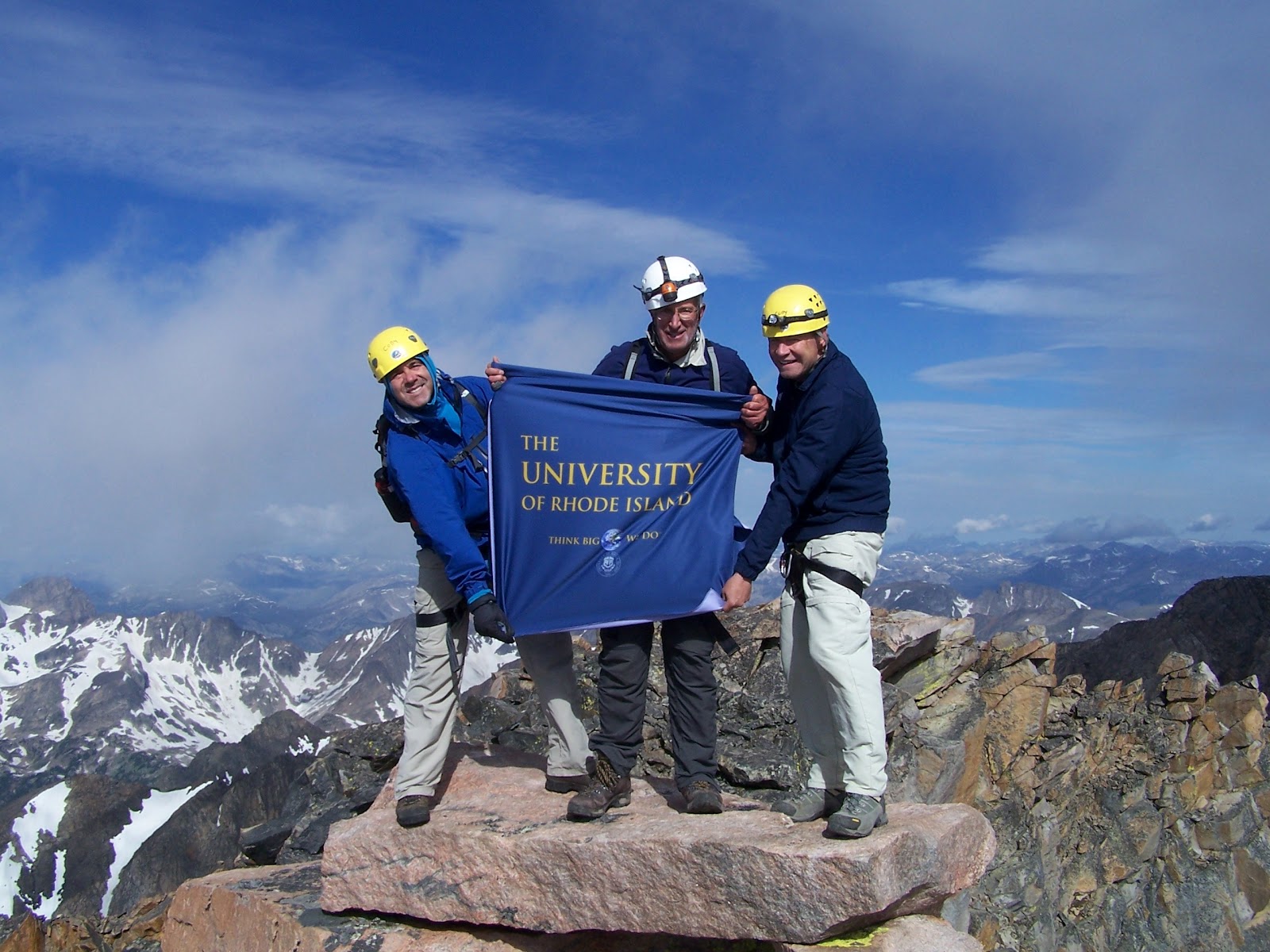
Bruce Gouin (1974) of Arrowhead Dental Associates here in Rhode Island also attended.  Shortly afterward he, Frank DeQuatrro (1983), an orthodontist in RI, and I set off for a different kind of highpoint: the summit of Granite Peak, the highest point in Montana.  Here is a brief account of our four-day climb and return.


Here is a view of Granite Peak from the "high camp" on Froze to Death Plateau.


A closer view of Granite (again from Froze to Death Plateau). The route to the summit
initially follows the ridge on the left and then moves to the back of the peak.


Left to Right on the summit of Granite Peak: Frank, Bruce, and me.  Elevation about 12,800 ft.  


Coming down after the climb: Bruce, me, our guide, Phil, and Frank.
Mystic Lake (elev. ~ 7,000 ft) is below us.

Monday, June 4, 2012

Why Study the Arts and Humanities?


I recently returned from Europe following meetings with key partners in our acclaimed International Engineering Program – one of the University of Rhode Island’s most innovative and effective educational programs.  Our program was, in fact, recently featured in the Chronicle of Higher Education.  My schedule has not been conducive to writing. Commencement occupied practically every moment since returning from the trip. The normal inclination would be to write on an aspect of Commencement, but I wanted instead to take the time to write on another subject.  That topic, in my opinion, is just as important, although perhaps not as obviously so, as educating engineers who are fluent in languages other than English, and who possess genuine cross-cultural competencies.
It appears inevitable, in the current climate, for commencement to stimulate stories in the media about the bleak job market for new graduates.  That is a very real concern for many of our graduates and their families.  What should be done?  Well, practically everyone recognizes that the employment prospects for college graduates are a function of one’s major.  Graduates in science, engineering, a professional field, or business generally do have more options and an easier path to a job directly related to their major.  In contrast, graduates in the arts and humanities are generally believed to have significantly fewer opportunities, especially in this current economy.  There is truth to that; there is also truth to the proposition that our nation could use more graduates in science, engineering, technology, and math. One consequence is that, for as long as I can remember, parents have been encouraging their kids to major in subjects that have an obvious and demonstrable connection to a job.  Frequently the son or daughter resists or rejects the advice. I saw a lot of this while on the faculty at Amherst College: parents encouraging (or even demanding) that their student prepare for business, medicine, or law – and the student choosing another path.  And that, much more often than not, turned out just fine.
Yes, unemployment and underemployment of college graduates is higher now, and student debt has grown alarmingly.  These are consequences of a severe and prolonged economic downtown coupled with the systematic disinvestment in public higher education by government in America. 
But, study of the humanities and the arts also remains valuable, for a wide variety of reasons. Not least, a strong liberal arts education can provide a valuable foundation for careers in a host of areas, as wonderfully demonstrated by the University of Rhode Island’s student commencement speaker, Mary McGunigal, who majored in Classics but is headed to the Mount Sinai School of Medicine.  The skills of critical reading and thinking, strong writing, and effective presentation are essential in practically any career. The ability to learn continuously, to teach oneself, are also more important than ever.  Creativity, a strong work ethic, self-discipline, and teamwork have always been, and will continue to be, keys to success.   All of our majors at the University of Rhode Island provide students the opportunities to develop these attributes.  There is a lot of evidence to indicate that a strong liberal arts education can be the foundation for success after college.  Most notably, even a cursory examination of the worlds of business, health, education, law, communications, and many others reveals that all of them are highly populated by leaders and professionals whose academic backgrounds are in the humanities and the arts. 
Despite this, it is probably natural that in tough economic times students tend to gravitate towards majors that have a more direct connection to employment possibilities. As one possible indicator of this, a recent NSF report showed that graduate enrollments in science, health, and engineering had grown by 30% over the last decade.  On the whole, that is a good thing, I think.  But what if your talents and interests while in college lie in areas other than science, engineering, health, or business?  A well-worn truism, that retains substantial validity in my judgment, is to pursue what you are passionate about, to study those things that you are truly, and deeply, motivated to study. A great example for me is the career of URI’s commencement speaker and honorary degree recipient, Marlen Suyapa Bodden.  She majored in history and Spanish literature at Tufts. People might have thought that such a double major would be inadequate preparation if you really wanted to build a distinguished career and change the world.  If anyone shared that kind of assessment with Marlen, she did not listen – and consequently our nation and the world are a better place.  I believe that many of the University of Rhode Island’s recent graduates can have a similar impact, regardless of what they may have majored in.  Commencement is the time we most clearly acknowledge and celebrate the truth of that hope.  So I suppose this post turned out to be about commencement after all!