Wednesday, July 25, 2012

Summits


Many of you have heard me say that one of the true highpoints (or summits) of my time as President of the University of Rhode Island has been getting to know the university’s alumni.  Lynn and I had an unusual opportunity to meet more of our graduates when we hosted an event at our home in Bozeman, Montana. Alumni and members of their family came, in several cases, more than 100 miles (a couple more than 300 miles!) to join us.  Participants included Lee Mongeon (1952), Elizabeth Mongeon (1952), Alden Paterson (1958), Jessica Pugrud (1977), Dayl Taylor (1978), Jennifer Madgic (1998), Sandy Leclerc (2000) and members of the families, as well as guests.  We had a great time. Since many more alumni from the region sent their regrets along with their hopes that there would be another opportunity, Lynn and I will do this again.

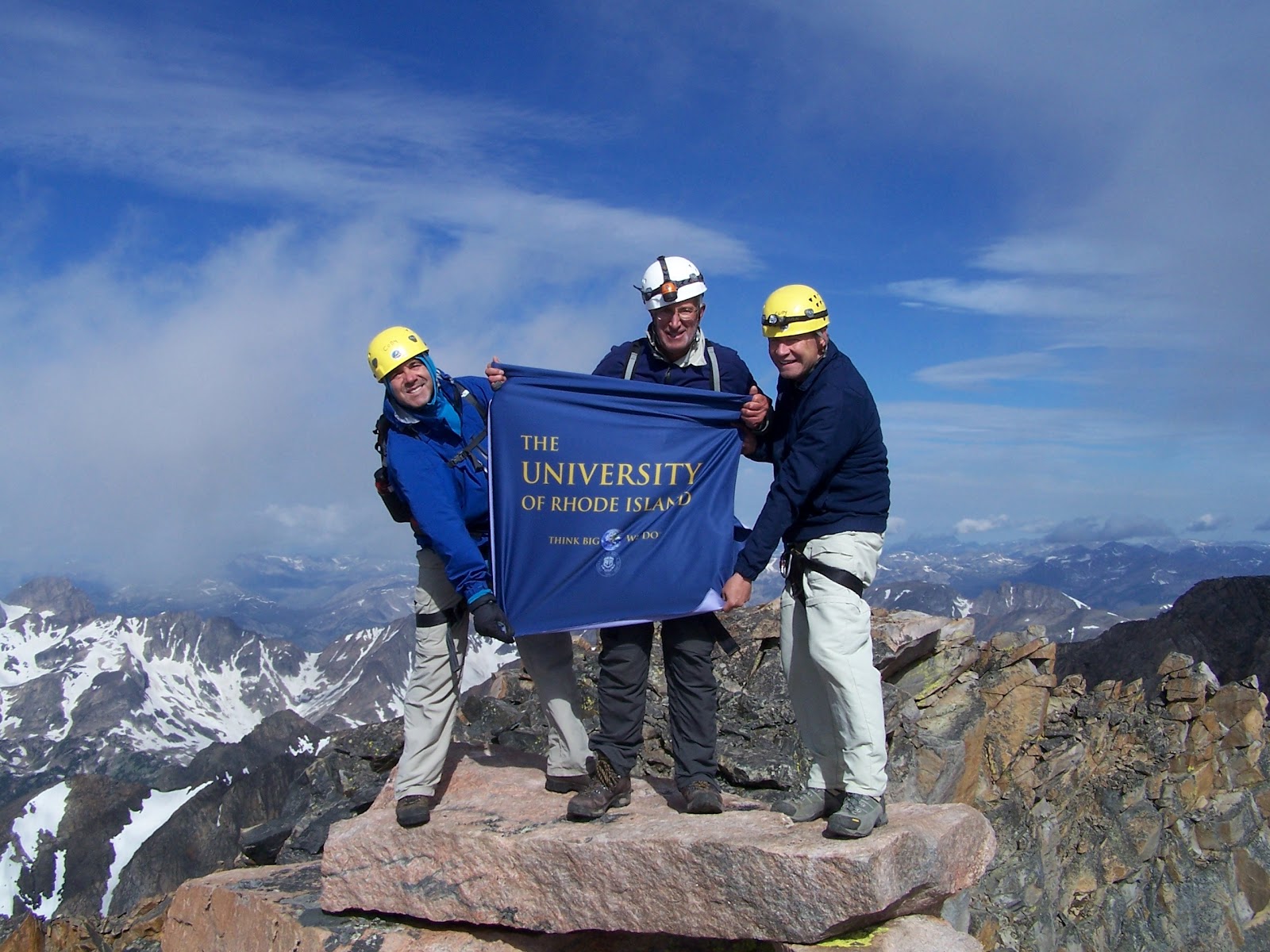
Bruce Gouin (1974) of Arrowhead Dental Associates here in Rhode Island also attended.  Shortly afterward he, Frank DeQuatrro (1983), an orthodontist in RI, and I set off for a different kind of highpoint: the summit of Granite Peak, the highest point in Montana.  Here is a brief account of our four-day climb and return.


Here is a view of Granite Peak from the "high camp" on Froze to Death Plateau.


A closer view of Granite (again from Froze to Death Plateau). The route to the summit
initially follows the ridge on the left and then moves to the back of the peak.


Left to Right on the summit of Granite Peak: Frank, Bruce, and me.  Elevation about 12,800 ft.  


Coming down after the climb: Bruce, me, our guide, Phil, and Frank.
Mystic Lake (elev. ~ 7,000 ft) is below us.

Monday, June 4, 2012

Why Study the Arts and Humanities?


I recently returned from Europe following meetings with key partners in our acclaimed International Engineering Program – one of the University of Rhode Island’s most innovative and effective educational programs.  Our program was, in fact, recently featured in the Chronicle of Higher Education.  My schedule has not been conducive to writing. Commencement occupied practically every moment since returning from the trip. The normal inclination would be to write on an aspect of Commencement, but I wanted instead to take the time to write on another subject.  That topic, in my opinion, is just as important, although perhaps not as obviously so, as educating engineers who are fluent in languages other than English, and who possess genuine cross-cultural competencies.
It appears inevitable, in the current climate, for commencement to stimulate stories in the media about the bleak job market for new graduates.  That is a very real concern for many of our graduates and their families.  What should be done?  Well, practically everyone recognizes that the employment prospects for college graduates are a function of one’s major.  Graduates in science, engineering, a professional field, or business generally do have more options and an easier path to a job directly related to their major.  In contrast, graduates in the arts and humanities are generally believed to have significantly fewer opportunities, especially in this current economy.  There is truth to that; there is also truth to the proposition that our nation could use more graduates in science, engineering, technology, and math. One consequence is that, for as long as I can remember, parents have been encouraging their kids to major in subjects that have an obvious and demonstrable connection to a job.  Frequently the son or daughter resists or rejects the advice. I saw a lot of this while on the faculty at Amherst College: parents encouraging (or even demanding) that their student prepare for business, medicine, or law – and the student choosing another path.  And that, much more often than not, turned out just fine.
Yes, unemployment and underemployment of college graduates is higher now, and student debt has grown alarmingly.  These are consequences of a severe and prolonged economic downtown coupled with the systematic disinvestment in public higher education by government in America. 
But, study of the humanities and the arts also remains valuable, for a wide variety of reasons. Not least, a strong liberal arts education can provide a valuable foundation for careers in a host of areas, as wonderfully demonstrated by the University of Rhode Island’s student commencement speaker, Mary McGunigal, who majored in Classics but is headed to the Mount Sinai School of Medicine.  The skills of critical reading and thinking, strong writing, and effective presentation are essential in practically any career. The ability to learn continuously, to teach oneself, are also more important than ever.  Creativity, a strong work ethic, self-discipline, and teamwork have always been, and will continue to be, keys to success.   All of our majors at the University of Rhode Island provide students the opportunities to develop these attributes.  There is a lot of evidence to indicate that a strong liberal arts education can be the foundation for success after college.  Most notably, even a cursory examination of the worlds of business, health, education, law, communications, and many others reveals that all of them are highly populated by leaders and professionals whose academic backgrounds are in the humanities and the arts. 
Despite this, it is probably natural that in tough economic times students tend to gravitate towards majors that have a more direct connection to employment possibilities. As one possible indicator of this, a recent NSF report showed that graduate enrollments in science, health, and engineering had grown by 30% over the last decade.  On the whole, that is a good thing, I think.  But what if your talents and interests while in college lie in areas other than science, engineering, health, or business?  A well-worn truism, that retains substantial validity in my judgment, is to pursue what you are passionate about, to study those things that you are truly, and deeply, motivated to study. A great example for me is the career of URI’s commencement speaker and honorary degree recipient, Marlen Suyapa Bodden.  She majored in history and Spanish literature at Tufts. People might have thought that such a double major would be inadequate preparation if you really wanted to build a distinguished career and change the world.  If anyone shared that kind of assessment with Marlen, she did not listen – and consequently our nation and the world are a better place.  I believe that many of the University of Rhode Island’s recent graduates can have a similar impact, regardless of what they may have majored in.  Commencement is the time we most clearly acknowledge and celebrate the truth of that hope.  So I suppose this post turned out to be about commencement after all!

Saturday, April 21, 2012

Frivolous (or at least misguided) Suggestions to “Improve” Higher Education


OK, in my most recent post I argued that it is time to be really serious about the problems confronting American higher education, especially public colleges and universities.  I implied that some of the “problems” and some “solutions” were, well, less than serious. That raises the obvious question: So what specifically do you regard as less than serious or even frivolous contributions to the discussion?  Here’s my answer.  I apologize in advance for its length, but, even so, there is a lot more that could be said on these complex issues.
First, let’s end the foolishness of talking endlessly about access and affordability while saying nothing about quality.  Yes, the student loan situation is a looming crisis that we absolutely must address. But there is one thing worse than graduating from college with a lot of debt.  That is graduating from college unprepared to succeed in the intensely competitive global economy.  In fact, that’s much, much worse.
Second, let’s acknowledge that not everyone needs a college education.  There are good jobs out there that do not yet require one.  But a lot of the best jobs and careers do, and will continue to, require some amount of post-secondary education, if not a college degree or even a graduate degree.  And the percentage of the jobs that do will likely increase.  A college degree is still the greatest driver of upward mobility in America. That said, we should pay no attention to those who argue that a college education is no longer needed based on the success of a Steve Jobs or a Bill Gates. That is just silly.  These individuals are extremely rare. Moreover, this argument completely ignores the fundamental fact that the success of Apple and Microsoft is built on the innumerable, essential contributions of thousands of engineers, programmers, designers, managers, business professionals, and more – the vast majority of whom have college degrees.  While the odds of any particular 20-year-old being the next Bill Gates or Steve Jobs are very low, the opportunities to build a successful, productive, rewarding career – or a new company  – in the technology sectors of the global economy are still high, but only if you go to college.
Next, let’s dispense with the tripe that distance education is some kind of panacea for the issues surrounding access, quality, and affordability. That’s not to say that distance education and web-based learning are unimportant. To the contrary, they are essential tools to improving learning and access. We in higher education should be “all in” with regard to adopting, implementing, and developing technologies to improve access and student success.  The lecture is far past its expiration date for many of our classes.  However, teaching in laboratories, in the field, seminars, supervised internships, studios, and tutorials is more important than ever, and cannot be satisfactorily replicated on line, if at all.  Nor should we underestimate the value of students and faculty interacting face to face in a learning and social community, developing relationships and interpersonal skills not readily created through distance learning. One of the most important advantages of teaching-learning technology is to free up faculty time for engaging students directly in hands-on learning, research, and creative work.  Especially in science and engineering (which continue to be among our nation’s critical needs) laboratory or fieldwork, or both, is simply a necessity.  A virtual laboratory does not adequately replicate being in a laboratory, actually conducting experiments, and making your own mistakes. A video of a stream is not the same as standing in it, sampling the water or the organisms, or just closely observing an ever-changing microenvironment. Designing and building a robot is completely different than watching one.  There’s a lot more that could be said in this context, but I hope you get the idea. 
While we’re at it, let’s develop a realistic attitude towards “for-profit” education. It certainly has its place among America’s higher education options. It serves a lot of students very well.  It has, and can continue to, teach public and private colleges and universities a lot, particularly with regard to high-quality distance and web-based teaching strategies.  But it must also be remembered that the primary constituency of a for-profit institution is its owners or shareholders. The primary motivation is, well, profit.  It seems to me that students tend to be regarded as customers.  I think that attitude is fundamentally flawed.  Students are not our customers, they are, or should be, our partners.  A college education is not a commodity to be selected from a display like cornflakes or oatmeal.  I believe that a college education is a creative endeavor involving close collaboration between the student and the faculty.  Each must contribute to the creative process; without that partnership some type of credential may be awarded, but the kind of education that would most benefit the student has not been created.  Also, we should not lose sight of the fact that net revenue is a leading driver of academic offerings at for-profit institutions. It is one reason, I suspect, that programs in science, engineering, clinical practice, and anywhere where small student/faculty ratios are required, tend to be underrepresented in that sector.
Of course, net revenue considerations are also a part of the planning and resource allocation strategies of public colleges and universities.  In the current fiscal climate the need for such considerations is frequently acute. A net revenue approach can be valuable in multiple contexts, such as setting priorities and insuring that resources follow students.  It can also all to easily get out of hand.  Expensive programs in the sciences, engineering, nursing, pharmacy, and allied health, are unarguably critical to our future. So are philosophy, literature, foreign languages, history, the social sciences, the arts, and yes, even, anthropology.  Even in the midst of financial affliction, we must constantly keep the fundamental purposes of higher education foremost in our planning and decisions – one of those purposes is to prepare our students for success as thoughtful, knowledgeable, informed, and engaged citizens. 
Finally, can we dispense with the specious argument that faculty productivity and salaries are a major cause of rising costs? Faculty salaries, even for those on the tenure-track, have been nearly stagnant for several years, especially at public colleges and universities.  Moreover, practically everyone knows that adjunct faculty are increasingly teaching our students and that the percentage of tenure track faculty has been declining. Why? Because adjuncts are substantially cheaper, particularly if part-time. The trend towards more adjuncts and part-time faculty needs to be reversed, not exacerbated. Are there slackers out there? Of course.  Would increased accountability be useful? You bet. Those are problems we have the tools to fix.  In fixing those problems let’s not lose sight of the fact that our faculty generally work hard, accomplish a lot, care about students, and are passionate about teaching, scholarship, and service.  For many colleges and universities I think the data indicate that our faculty deserve more, not less, in terms of salary. 
Whew! I’m glad to get all that off my chest. I feel better, although you probably don’t. Thanks for reading anyway.

Friday, April 13, 2012

Let's Be Serious

A memorable line from the movie The American President is: “We have serious problems to solve, and we need serious people to solve them.” It is a line for our time in higher education. Each day seems to bring a new problem to the fore. The list of problems appears endless: student loan debt, institutional debt, rapidly increasing tuition, achievement gaps, corporatization, the erosion of tenure, the future of the humanities, athletics scandals and spending, deferred maintenance, growing restrictions on student access, escalating demand to attend college, reductions in research funding, international competition, too few opportunities for new (or not so new) PhDs, the “graying” of the faculty, the lack of diversity among senior leaders – and we can add a lot more to that list. It can be depressing if one dwells on it.

There also appears to be no shortage of proposed solutions to at least some of these problems: let’s privatize, abolish tenure, foster “destructive” innovation, outsource, consolidate, partner, grow, shrink, provide credentials not degrees, increase oversight – and we can add a lot more to that list, too. Some of the proposals that have been made are worthwhile, some are misguided, some are frivolous, and some are really threats.

In order to solve a problem you must be able to identify it – but in the current context for higher education that is less obvious that you might first think. If you set out to design the next generation airliner, say the Boeing 787, everyone understands that if you elegantly solve all the design problems, but leave off the engines, you are unlikely to sell many aircraft, and even less likely to get passengers from Boston to Shanghai. Yet many of the solutions to the multiple problems facing higher education are just like that – useful, even necessary (like landing gear), but ultimately irrelevant without the engines. Unless we address the fundamental problems of funding, for both public institutions and for students, the rest of our efforts will not matter very much.

A recent report, a new addition to a substantial group that reach the same conclusion, cogently documents the engine problem for public higher education. The paper is aptly titled, “The Great Cost Shift. How Higher Education Cuts Undermine the Middle Class.” The author is John Quinterno, writing for Demos, a non-partisan public policy research and advocacy organization in NY, www.demos.org. The numbers for Rhode Island are especially sobering. In 1990-91 Rhode Island provided $205 per capita or $6.71 per $1000 of personal income to public higher education. By 2010-2011 those values had declined to $150 per capita and $3.55 per $1000 of personal income. Now that is a serious problem.

Moreover, it is a fundamental problem, and until this problem is solved we will have a difficult time really solving any of our myriad other problems. For example, the tension between maintaining and improving quality on one hand (which requires us to develop, recruit, and retain the best faculty and staff we can), and minimizing tuition increases on the other, is increasingly problematic in the context of systematic declines in state support.

The public disinvestment in higher education is a national problem, which makes it even more difficult to solve. But solve it we must, for the benefit of our state and our nation. Finding a solution requires a serious examination of the problem by serious people committed to the search. Currently, here in Rhode Island, the Board of Governors for Higher Education, the General Assembly, and the Governor’s Office have all engaged the issue of access and affordability, which is encouraging. But we must directly face the reality that the “cost” crisis is in fact a funding crisis. We have a long way to go to solve that problem, and no time to waste.

Monday, April 2, 2012

Learning by Doing

This past Thursday, the University of Rhode Island celebrated the creation of the Office of Experiential Learning and Community Engagement. It was a special moment for URI because it highlighted the vision, dedication, and work of many talented individuals among the faculty, staff, and administration of the university. Further, the day represented the interests and accomplishments of generations of URI students, who have consistently understood the enormous value of participating in research, scholarship, internships, and community service. An admirable cross-section of the URI community turned out, and we were joined by Governor Lincoln Chafee and Senator Dawson Tucker Hodgson.

Each of our speakers – Governor Chafee, Dean Jayne Richmond, Provost Don DeHayes, Jay Petrella (Vice President for Human Resources, Citizens Bank), Dr. Roger LeBrun (Professor, College of the Environment and Life Sciences), Jason Allard (a URI student majoring in psychology) and Kim Washor (Director of the Office of Experiential Learning and Community Engagement) – addressed the substantial advantages of “hands-on” learning.

Importantly, these advantages do not accrue solely to the students, but also to the companies, non-profit organizations, or communities that provides the opportunities for students to be engaged. Indeed, one of the most important contributions provided by research universities to the well being and economic development of the nation is the talent and energy of our students. Students from the University of Rhode Island long have been, and continue to be, involved throughout the state. Our faculty are frequently involved as well.

The Office of Experiential Learning and Community Engagement will serve as the central portal for students, faculty, businesses, and community organizations. The Office will help catalyze the continued growth of experiential learning at the University of Rhode Island. It will facilitate the increasing engagement of the university with the people, businesses, and communities of the state, and even beyond Rhode Island’s borders.

The engagement of undergraduates in research, scholarship, creative work, experiential learning and service learning are integral parts of the University of Rhode Island’s Academic Strategic Plan. And that is as it should be. Why? Because the learning opportunities created by such engagement cannot be replicated in our classrooms and web-based learning environments. Our role is to prepare students to help solve the global challenges of the 21st century and to prepare them for jobs and careers that do not even yet exist. The skills, expertise, and adaptability required for success can best be gained by confronting problems that have not been solved, by attempting to do, or create, things that are new, and by pursuing fresh solutions to society’s problems. Together with the faculty and our partners, this is what the Office of Experiential Learning and Community Engagement seeks to accomplish.

Monday, February 20, 2012

Loss and Community

Recently our URI community suffered two devastating losses: the deaths of Erica Knowles, a senior studying journalism and women’s studies, and Professor Peng Wang, a young faculty member in Chemical Engineering and Pharmaceutical Science. Each loss leaves a gaping hole in our community - voids that only they could fill. This past Saturday we gathered to mourn their loss and to celebrate their lives. Such events, although desperately necessary, are difficult for all concerned, especially for the families and those who love them. I very much appreciate their generosity in allowing the larger URI community to join with them to say good bye, and to share in both the grief of loss and the warmth of remembering.
Erica had long been a part of Rhode Island and South County, whereas Dr. Wang had only recently joined the University of Rhode Island faculty, and was born and grew up in China. On the surface the memorial services were very different, shaped by the distinct cultures, histories, and relationships of those whose lives we celebrated. But at the end of a long Saturday, I was left with the abiding conviction that our common humanity, intensely shared among a community at such moments, transcends all the differences of religion, language, culture, and history.
It is good to be reminded of that. Many people struggle with the questions of whether our lives have real meaning, or whether our decisions and choices ultimately really matter. The questions are ancient ones, and posed in many ways and venues. We seem to be living in a time where those questions are becoming more pointed and more urgent, in part the consequence of modern science and its increasingly mechanistic understanding of humanity. Alfred North Whitehead pointed this out in his 1925 Lowell Lectures at Harvard University, published as Science and the Modern World. He quotes Tennyson’s famous poem, In Memoriam: “The stars, she whispers, blindly run.” Whitehead argues that this line reflects the appalling possibility (to Tennyson and many others) that, since the laws of physics “blindly run”, that our lives, consequently and inescapably, blindly run.
It is not easy to conclusively refute that possibility. But the two funeral services reminded me that love matters, that friendship matters, and that therefore our lives matter. Our choices, our actions, the relationships we build, and the connections we make can bring us together in a community where what we share is far greater than our individual contributions. Last Saturday, we came together in grief, but in sharing that grief, expressing it alongside our love and appreciation for those we lost, we came away with shared memories, closer ties, and renewed hope. Remarkably, I think, community such as that evident on Saturday can provide powerful testimony to the possibility that our lives are not governed solely by the laws of physics and chemistry, that our lives together do not “blindly run”, and that we can create a future that is better for all.

Tuesday, February 14, 2012

The State of College Affordability

In his State of the Union address, President Obama elevated the issue of the rising costs of higher education to a new level – a step that, in my view, was long overdue. America can certainly benefit from comprehensive and inclusive discussions of the critical social, economic, and public policy issues surrounding access to, and affordability of, higher education. Students, their families, colleges and universities, the federal and state governments, communities, businesses – all should be involved because everyone has a stake in the outcome. Indeed, one can argue that the President was responding to the growing popular demand, exemplified by elements of the Occupy Movement, for urgent attention to the questions of access and affordability.

The problem has been widely recognized: for well over a decade. The costs of higher education have been steadily rising, and at a rate that exceeds the consumer price index as a measure of inflation. For public colleges and universities, the underlying reason (as I have pointed out previously) is the systematic disinvestment in higher education by state governments. The behavior of state governments in this regard is not fundamentally irrational: in the face of ever increasing costs for such things as mandated entitlements, health care, public safety, corrections, and pensions, funding for higher education was increasingly viewed as discretionary. After all, if colleges and universities needed funds beyond those provided by the state, they could always raise tuition. And they did.

For some time this strategy worked acceptably well because in many states public higher education was inexpensive. But after several years of budget reductions and concomitant tuition increases, this is no longer the case for many students and families. Here at the University of Rhode Island two recent events powerfully highlighted the situation. The first was the testimony presented by students, alumni, and faculty at a hearing on campus by the Special House Commission to Study Public Higher Education Affordability and Accessibility in Rhode Island (see www.uri.edu/news/releases/index.php?id=6102), followed by the Occupy URI forum (see our current home page).

It is encouraging for us in Rhode Island that the multiple issues associated with the cost of public higher education are gaining increased attention. Crafting solutions will not be easy or simple. There are several other, well recognized, problems facing our state that also require urgent attention. However, most of the problems we face, including access and affordability of higher education, could be addressed far more readily if additional resources were available. I believe that the best and most sustainable path to increasing our resources is to grow the economy. This growth must happen sooner than later, it must be substantial, and it must be based on innovation. Discovery, technology transfer, entrepreneurship, and a highly prepared workforce are all essential to building a competitive 21st century economy. These are all things at which URI can excel. Consequently, access to affordable, excellent public higher education is a critical component of constructing solutions to the many challenges facing our state, and our nation.